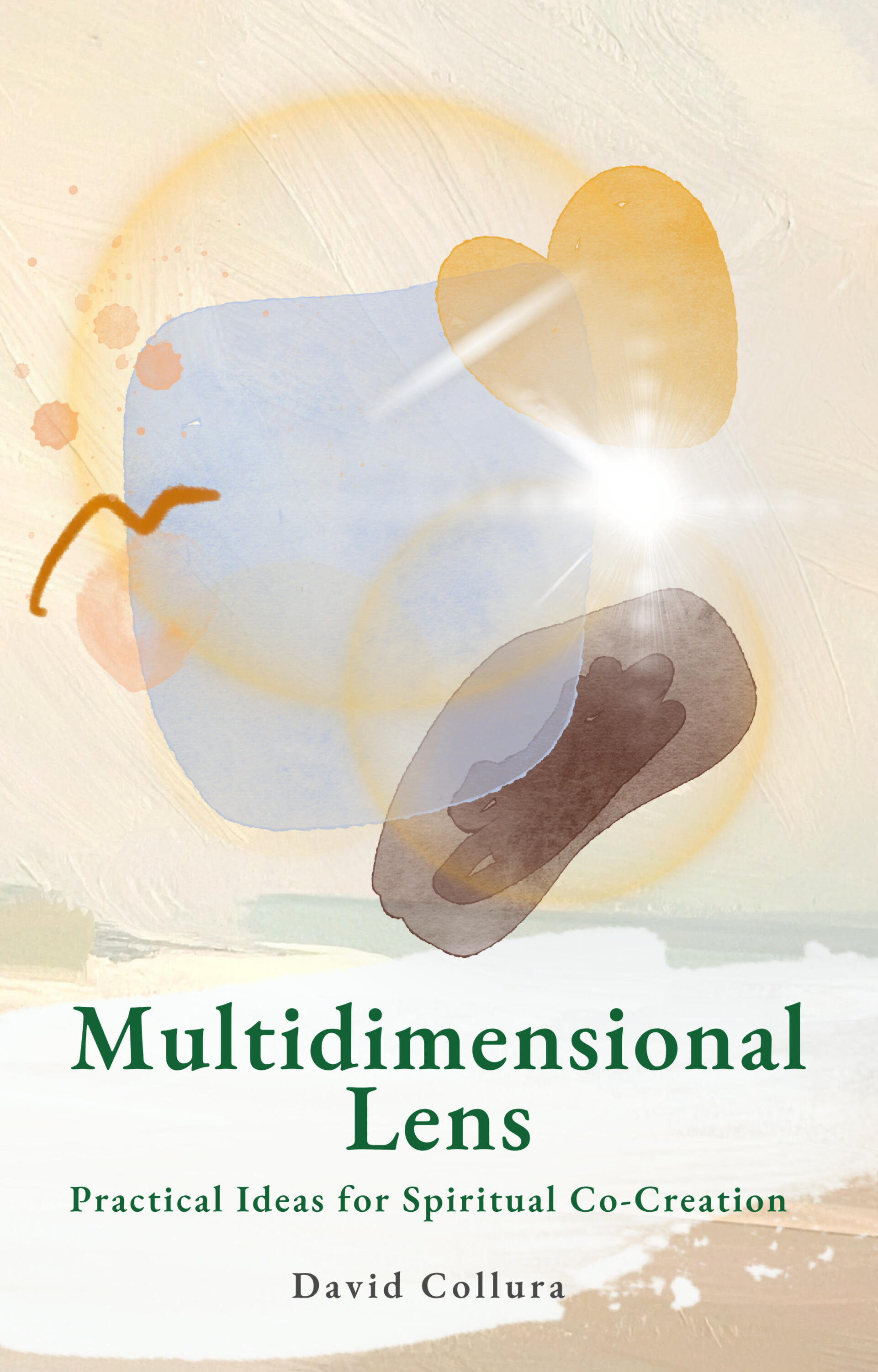
Multidimensional Lens - Press Kit
Launched April 2026 / Audiobook coming May 2026
By David Collura. A first book about taking the risk of trusting your experiences and exploring what it means to be a multidimensional person. To book an interview: [email protected].

About David
David Collura has taught classes on spirituality, energy, and non-ordinary states of awareness for more than fifteen years, previously with the International Academy of Consciousness and more recently with Mosaic Wellness and Education, a nonprofit he co-founded in 2018 with his wife Ashley and three colleagues. Multidimensional Lens: Practical Ideas for Spiritual Co-Creation is his first book. He records the audiobook himself, from a walk-in closet, because the writing wants to be spoken.
About the Book
This is a book about taking the risk of trusting your experiences. Drawing from over fifteen years of teaching spirituality and consciousness, David brings the bizarre bounty of his interior life - rugged, imperfect, with weird edges that don't always line up. Part open-source framework for engaging life in many dimensions, part living memoir of a fellow traveler, Multidimensional Lens explores how small shifts in how we see energy, relationships, and our own multidimensional nature can open up real possibilities for co-creation. These are personal ideas shared without manicure, in the hope that you find room to breathe in these words.
Conversation Angles
The dirty potato: Why authentic, unmanicured spirituality matters more than the polished version, and what happens to a teaching when it gets too clean. The through-line of the book.
The teacher who hides: David taught for over fifteen years before publishing, and barely told friends he taught at all. What it costs to keep the hemispheres of a life separate, and what it took to reconcile them on the page.
Energy as something you can go deeper with: Most people already sense energy — in rooms, in other people, in their own body after a hard day or a good one. This conversation is about what opens up when that intuitive sense becomes a skill: what energy actually feels like when you start working with it directly, and why the development is worth the investment.
The Multidimensional Lens itself: Three small shifts (energy, the persistence of life, multidimensional support) framed as orientations rather than beliefs. Why "open-source" rather than "system".
The persistence of life as the logical position: Treating many lifetimes as the more parsimonious view, not the exotic one, and how that quietly changes the experience of urgency, regret, and time.
Nonviolence beyond no-fists: The connection between condemnation, control, and harm, and what a more honest practice of nonviolence asks of us (including toward ourselves).
A connoisseur of escapism: What addiction recovery groups have in common with spiritual seekers, what "extraction" looks like energetically, and why pitying the lost without shame is a workable starting point.
The value of the almost-OBE: The experience of nearly leaving the body and what the partials teach about presence, fear, and the body's role in non-ordinary states.
Energetic hygiene, including the boring parts: Showering, walking, eating, sleeping, breathing. Why the most reliable energetic practices are often the least exotic.
Multidimensional pressure: The phenomenon of difficulty intensifying right before meaningful change or gathering, how to read it as signal rather than stop sign, and why sometimes the pressure has a source that needs to be addressed directly.
Working with evolutionary guides: Why this isn't a magical-thinking add-on, and how a working relationship with a wider field of help can stay grounded.
Sample Interview Questions
You taught for over fifteen years before setting out to write a book. What were you waiting for, and what changed?
The book uses the word "energy" carefully. Most people already have some intuitive sense of what it means — what opens up when you start working with it as an actual skill?
You describe three small shifts that make up the Multidimensional Lens. Can you walk us through one of them in a way that someone listening on their commute could actually try?
You're explicit that this is an open-source framework, not a system. Why are you so allergic to the system version?
You talk about the persistence of life across lifetimes as the more reasonable position. How did you come to that, and what does it actually change day to day?
There's a chapter on nonviolence that goes well beyond not hitting people. What's the harder part of nonviolence for you?
You describe yourself as a connoisseur of escapism. What did you become a connoisseur of, and what did you learn from it?
The book treats out-of-body experiences as one node in a much larger field and gives a lot of attention to the partials and almost-experiences. Why?
What's the most boring energetic practice you rely on?
You write about "multidimensional pressure," the way difficulty often intensifies right before a meaningful change. What's the mistake people most often make when they encounter it — and is there ever a case where the pressure itself is pointing at something that needs to be dealt with directly?
You write about evolutionary guides without it ever feeling like magical thinking. How do you keep that practice grounded?
The audiobook is a big deal to you. You called it the truest form of the work. What does the writing do when it gets spoken that it doesn't do on the page?
If a reader takes one thing from Multidimensional Lens and forgets the rest, what would you most want it to be?
Bios for Show Notes
Short (~30 words) David Collura has taught classes on spirituality, energy, and non-ordinary states of awareness for over fifteen years, with the International Academy of Consciousness and Mosaic Wellness and Education. Multidimensional Lens is his first book.Medium (~75 words) David Collura has taught classes on spirituality, energy, and non-ordinary states of awareness for more than fifteen years, previously with the International Academy of Consciousness and more recently with Mosaic Wellness and Education, a nonprofit he co-founded in 2018 with his wife Ashley and three colleagues. Multidimensional Lens: Practical Ideas for Spiritual Co-Creation is his first book.Long (~150 words) David Collura has spent more than fifteen years teaching spirituality, energy, and non-ordinary states of awareness, first with the International Academy of Consciousness and, since 2018, with Mosaic Wellness and Education, a nonprofit he co-founded with his wife Ashley and three colleagues. He writes the way he teaches: personally, without manicure, willing to look clumsy if clumsy is the truer word. Multidimensional Lens: Practical Ideas for Spiritual Co-Creation is his first book, part open-source framework and part living memoir of a fellow traveler trying to make energy, relationships, and a multidimensional life practical instead of dogmatic. He records the audiobook himself, from a walk-in closet, because the writing wants to be spoken.
Booking & Logistics
For interview requests: [email protected]. Replies within two business days. David records audio on a Samson Q9U and video on an OBSBOT Tiny 2 and is comfortable on all major meeting platforms. Pronunciation: Collura (cuh-LOOR-uh).
Asset Downloads